
Distinguishing Imported Fire Ants from Carpenter Ants in South Texas Yards
Learn how to tell red imported fire ants apart from carpenter ants in South Texas yards by comparing their appearance, nesting habits, and behavior.
South Texas homeowners know that spotting ants in the yard is almost a daily occurrence once temperatures climb. Around Somerset and neighboring properties, sandy loam soils, native mesquite and oak trees, and long warm seasons create ideal conditions for several ant species. Two of the most frequently confused and troublesome pests in our region are the red imported fire ant and the carpenter ant.
At a quick glance, telling them apart is not always obvious. While many people picture carpenter ants as purely black, several species found in South Texas feature reddish-brown and black coloring that looks surprisingly similar to a fire ant. Still, these two insects pose completely different risks to your family, pets, and home, and they require very different treatment strategies. Knowing how to distinguish imported fire ants from carpenter ants helps you protect your property effectively from the start.
Physical Differences Between Fire Ants and Carpenter Ants
The most reliable way to begin identifying an ant is by looking closely at its size, coloration, and body shape. Even without a magnifying glass, a few visual details separate these two species once you know what to watch for.
Size and Uniformity Within a Colony
Imported fire ants are relatively small, generally ranging from about an eighth of an inch to a quarter of an inch long. Inside a single fire ant mound, you will notice workers of varying sizes foraging together. Carpenter ants, by contrast, are among the largest ants you will encounter in a Texas yard. Larger workers can reach about half an inch in length, making them noticeably bulkier and easier to spot as they cross a patio or climb a tree trunk.
Color and Body Structure
Red imported fire ants typically have a coppery-brown or reddish head and thorax paired with a darker, almost black abdomen. In South Texas, carpenter ants may be solid black, dark brown, or distinctly two-toned with a dull red thorax and black abdomen. Because those bicolored carpenter ants share a similar palette with fire ants, body proportions become the clearer clue.
- Thorax profile: A carpenter ant has a smooth, evenly rounded upper thorax when viewed from the side, while a fire ant has a more uneven profile with a small dip.
- Waist nodes: Between the thorax and the abdomen, carpenter ants have one small bump or node, whereas imported fire ants have two distinct nodes.
- Jaws and stingers: Carpenter ants feature large mandibles built for chewing through wood and do not have a stinger. Fire ants have a stinger at the tip of their abdomen, which they use while gripping skin with their jaws.
Nesting Habits and Yard Clues
Where the ants live and what their nest looks like often provide the fastest answer outdoors. Imported fire ants and carpenter ants seek out completely different habitats across a Somerset property.
Imported Fire Ant Mounds
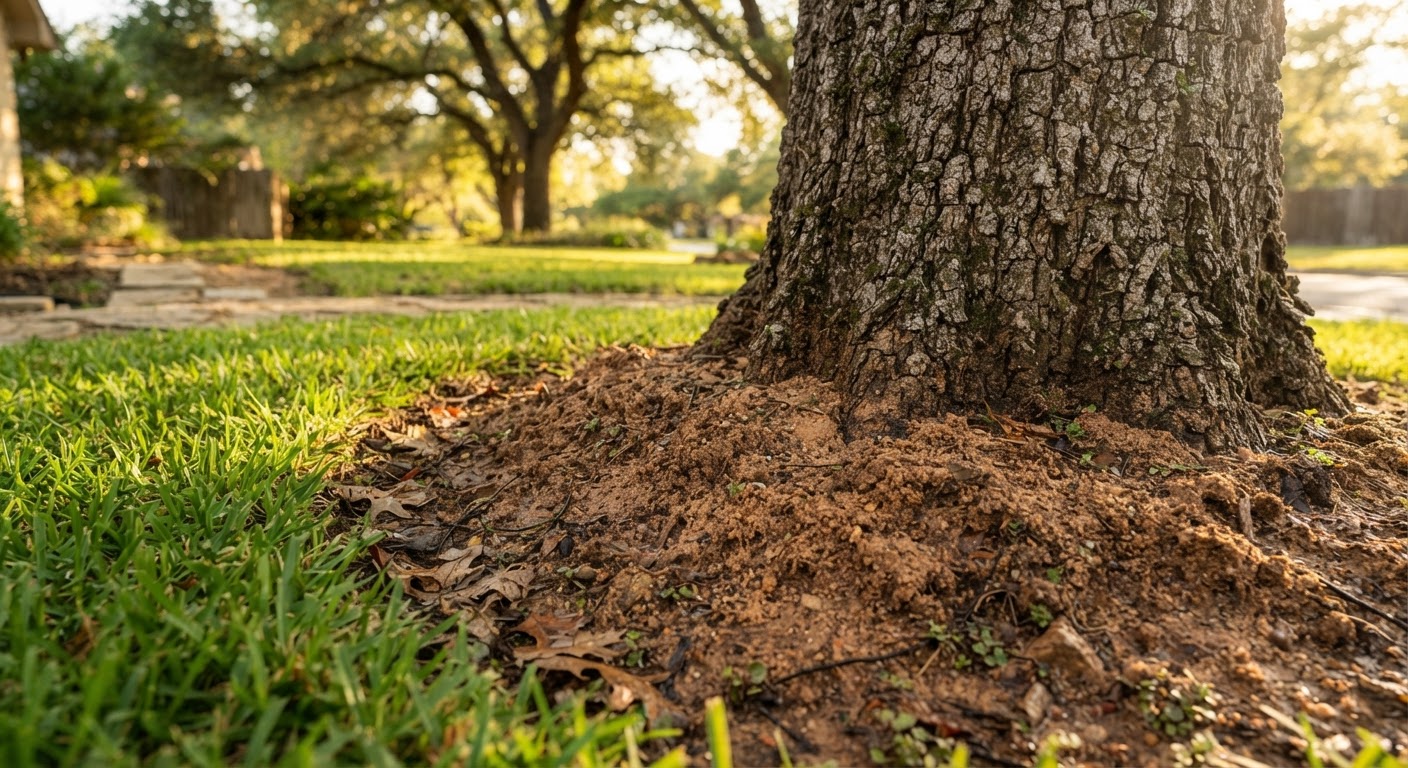
Imported fire ants are soil-nesting insects that thrive in open, sunlit spaces. You will usually find their mounds in front lawns, along driveways, near fence lines, around utility boxes, and along sunny pasture edges. A typical fire ant mound looks like a dome of loose, fluffy excavated dirt without a visible central entrance hole. Instead, workers enter and exit through underground foraging tunnels that branch out beneath the turf. After a heavy South Texas rain, fire ant mounds often become taller and more noticeable as the colony shifts upward into warmer, drier soil.
Carpenter Ant Nest Sites
Carpenter ants rarely build soil mounds in the middle of a sunny lawn. Instead, they look for moist, softened, or decaying wood. Outdoors, common nesting sites include hollow oak or pecan trees, rotting stumps, stacked firewood, aging landscape timbers, and wooden fence posts. Closer to a home, they often target moisture-damaged soffits, window frames, porch columns, or wall voids near plumbing leaks.
One telltale sign of a carpenter ant colony is frass. Because carpenter ants do not eat wood the way termites do, they excavate smooth galleries by chewing out fibers and pushing the debris outside. Beneath a tree hollow, wooden beam, or sill plate, you may spot small piles of coarse wood shavings mixed with dead insect parts and soil grit.
Behavioral Patterns and Activity Times
Observing how ants behave and when they appear offers another safe, practical way to tell them apart without getting stung.
- Reaction to disturbance: Lightly tapping the ground near a fire ant mound with a long stick triggers an aggressive swarm within seconds, with workers rushing upward onto anything touching the soil. Carpenter ants do not swarm lawns this way and usually scatter or retreat into wood crevices when disturbed.
- Peak foraging hours: Imported fire ants forage actively during warm daylight hours, especially in the morning and late afternoon. Carpenter ants are mostly nocturnal, emerging in larger numbers around dusk and staying active overnight along tree trunks, siding, and porch lights.
- Stinging versus biting: A fire ant locks on with its jaws and delivers a burning sting that often leaves behind a tiny white pustule. Carpenter ants cannot sting, though a large worker can give a sharp pinch with its mandibles if handled.
Why Accurate Identification Matters for Your Property
Mistaking one ant species for the other can lead to wasted effort and lingering pest issues. Both insects bring distinct problems to South Texas yards, and each calls for a targeted plan.
Imported fire ants create immediate safety concerns for anyone using the yard. Children playing on the lawn, pets exploring fence lines, and homeowners mowing or trimming can easily step into an inconspicuous mound. Beyond painful stings, fire ants are drawn to electrical equipment such as air conditioning condensers, well pumps, and irrigation control boxes, where nesting debris can interfere with wiring.
Carpenter ants are far less likely to ambush you in the grass, but their presence near a structure deserves prompt attention. While they do not consume wood for nutrition, an established colony gradually expands tunnels inside damp timber and framing. If satellite nests move indoors from a nearby tree, homeowners may spot large wandering workers in kitchens or bathrooms at night, which is often a sign of nearby moisture damage.
Practical Steps Homeowners Can Take
Reducing ant pressure around your property starts with making your yard less inviting to both species. A few routine maintenance habits help limit nesting spots before colonies grow large.
- Trim tree limbs and shrubs back from your roofline, siding, and fences to remove natural bridges carpenter ants use to reach the house.
- Store firewood on elevated racks away from exterior walls and pull thick mulch back a few inches from the foundation.
- Repair leaking outdoor spigots, clogged gutters, and drainage issues that soften wood trim and attract moisture-seeking pests.
- Inspect sunny lawn edges and utility pads regularly after rain so new fire ant mounds are spotted before family members or pets encounter them.
When dealing with active colonies, store-bought contact sprays frequently fall short. Spraying the top of a fire ant mound often kills only surface workers while prompting surviving queens to split and form new mounds elsewhere in the yard. Likewise, spraying wandering carpenter ants on a porch rarely reaches the parent colony hidden inside a decaying tree or wall void. Lasting control depends on identifying the species, locating primary and satellite nests, and applying treatments suited to that ant's behavior.
Reliable Ant Control for Somerset Homes and Yards
Whether you are dealing with aggressive mounds taking over your lawn or large ants trailing up trees and exterior walls after dark, proper identification is the first step toward effective relief. Parnovo Pest Defense Group serves homeowners in Somerset, TX with dedicated ant control, lawn and garden pest control, and preventive pest control suited to South Texas conditions. Contact Parnovo Pest Defense Group to schedule an inspection and keep your yard and home protected throughout the seasons.
Need help from Parnovo Pest Defense Group?
Contact our team to discuss your service needs in Somerset and surrounding service areas.